

Ask the new artificial intelligence tool ChatGPT to write an essay about the Treaty of Waitangi and you can watch it churn out paragraphs of information about the topic in a matter of seconds.
This impressive but controversial writing tool can generate paragraphs of text in a wide range of styles and formats such as news articles, poetry, and essays. The human-like nature of the writing tool has caused a stir in the education world. Is this the end of assessments as we know them? Or the beginning of other ways students can explore knowledge and understand information even better? There are arguments for both sides of the spectrum. It is important schools fully understand these AI tools and their impact on education.
What is ChatGPT?
ChatGPT is a language generation model developed by OpenAI that uses deep learning techniques to generate human-like text. It is part of a new generation of AI systems that can converse, generate readable text on demand and even produce novel images and videos based on what they have learned from a vast database of digital books, online writings and other media.
What is the impact of this technology on schools?
AI technologies are constantly becoming more sophisticated and accessible as time goes on. It is important for educators to understand these technologies and their impact on teaching and learning - both positive and negative.
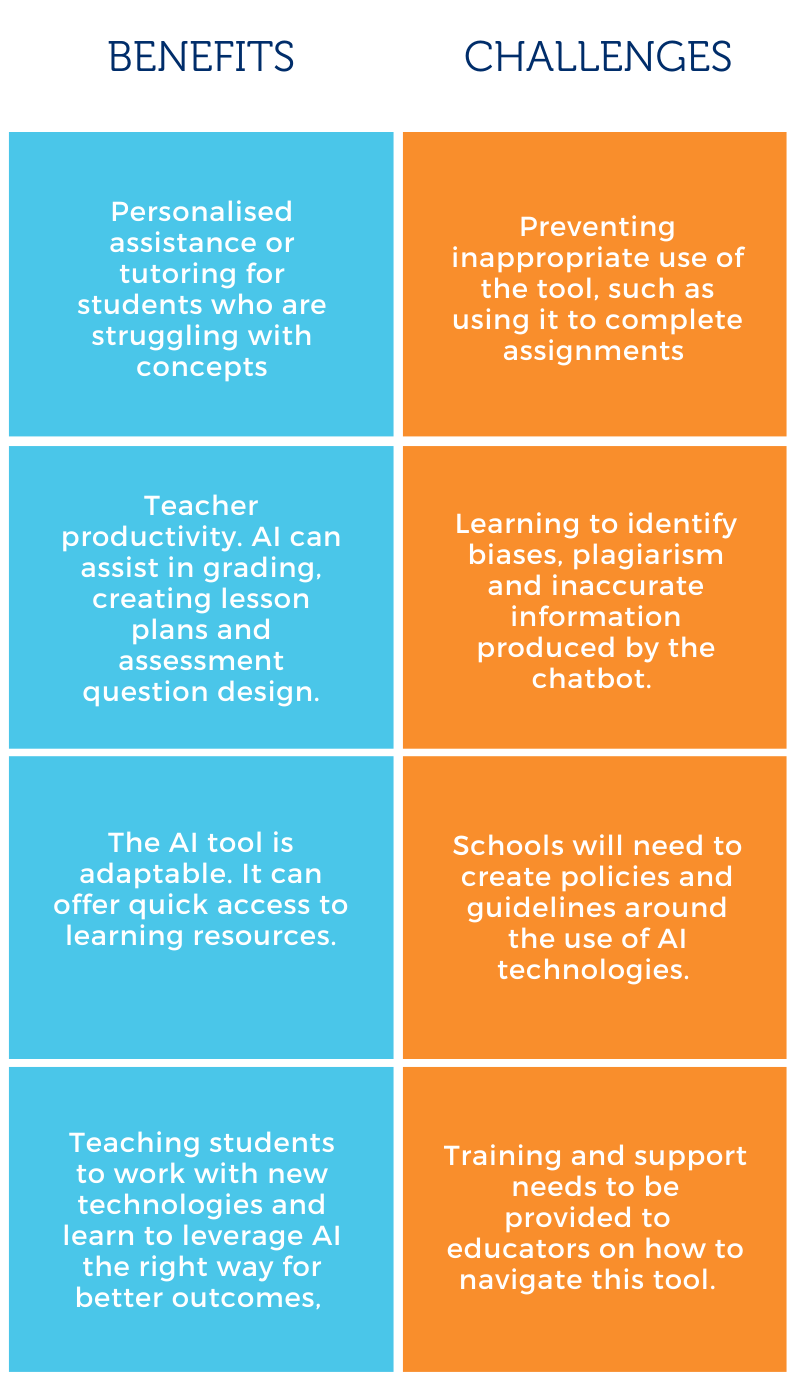
It can be argued that ChatGPT and other AI tools have the potential to greatly improve the learning experience for students and make education more accessible and effective. For example, ChatGPT can assist teachers with tasks such as grading assignments, and personalising teaching methods to each individual student's specific needs. On the other hand with the human-like nature of writing, there comes a lot of concerns.
Some concerns are the potential for privacy violations and the replacement of human interaction in the learning process. Additionally, overreliance on AI tools can lead to students lacking critical thinking and problem-solving skills. For example, students may use ChatGPT or other AI tools to complete assessments such as writing an essay or solving math problems.
Should ChatGPT be allowed?
On many social media platforms today, we can see content creators announce that their latest blog, video or image is sponsored by paid advertisement. Perhaps moving forward it will be common to use a similar note on anything created by AI. We can argue that any essay a student writes today will have been influenced by what they were taught in class, what they read online and how they drew their own conclusions. Can ChatGPT be viewed the same way? You can get several text options per topic, so reading them and combining them into a version that tells the story you want to tell should mean that you have completed the task and learnt something, right? Not all agree. Many schools are banning the tool from being used in their classrooms as it can hinder learning and expose students to harmful content. In fact, in Australia, many states have already banned the use of ChatGPT at school. Banning AI in the classroom has its challenges, as students can still access the tools elsewhere and it is difficult to determine when an AI tool has been utilised.
Before banning the tool outright, it is important to understand the technology, what other schools are doing, and ways your school can leverage the tool, whilst combatting the challenges that come along with it. Having conversations about your students, teachers and parents thoughts may be useful as well. Additionally, it is important that schools have a sound plan to manage these AI technologies safely and appropriately. Teachers and staff first need to be educated on how to navigate these tools before making policies around them. This can be a complex task and so it would be helpful if schools have a managed service provider (MSP), like New Era Technology, to lean on for support and guidance.
What can a managed service provider do to help schools navigate new technologies?
An IT managed service provider (MSP) can help schools address the concerns associated with using ChatGPT and other AI technologies in education in several ways:
Data security and privacy:
As students interact with ChatGPT and other AI tools, they may be providing sensitive personal information such as their school’s name and/or academic performance data. It is therefore imperative to ensure that this data is properly protected and not shared or used for any unauthorised purposes. An MSP can implement appropriate security measures to prevent any personal information breaches. An MSP, like New Era, can help schools by providing continuous monitoring of the AI systems and providing reports to the school's management in case of any issues. This helps to ensure that the systems are working as expected and that any issues are quickly identified and resolved.
Human-centred approach:
MSPs have a whole team of technology experts at their disposal. This means they can offer guidance to schools to implement AI technologies in a way that complements and enhances traditional teaching methods rather than replacing them. MSPs like New Era can work with your school to help educate your staff on these new technologies and develop a strategy to manage them effectively.
Technical support and maintenance:
An MSP can provide ongoing technical support and maintenance for AI technologies, to ensure that they are working properly and being used effectively. This can include troubleshooting issues, providing updates and upgrades, and providing training to teachers and staff on how to use the technology. If systems go down or there is a breach, New Era can offer quick support to get the issue fixed.
Collaboration with other educators:
As global IT providers as well as leading IT specialists in the NZ education industry, New Era is uniquely positioned to connect and consolidate the thinking, issues, and resolutions across schools both within and outside of the country. As a team of experts, we have dealt with a wide range of school IT issues, servicing many schools across New Zealand. We are aware of how to deal with common school IT problems and can help you find the best solution possible. It is also possible to connect you directly with practitioners who are grappling with similar scenarios so that you don't have to be at the cutting edge of the industry or have to try and solve things on your own.
Overall, an IT-managed service provider can help schools address the concerns associated with using ChatGPT and other AI technologies in education by providing expertise in the IT field in education, data security and privacy, and technical support and maintenance. They can help schools implement these technologies in a way that maximises their potential benefits while minimising any potential negative consequences. So before you ban these technologies, talk to a managed service provider like New Era to see if there is a way you can utilise them for your school's benefit.
We asked ChatGPT to write a poem for New Zealand schools, from New Era Technology, and this is what it came up with...