

Product design (UX/UI design) is becoming one of the most important roles in the tech industry. Designers are under pressure to accelerate product development and reduce the time, effort, and cost spent. We’ve been there and understand what it’s like.
This eight-step process can help you speed up development and achieve all of the above. Use it to understand your product goals and customers, and also to collaborate with the entire team to discover problems, ideate, test, and validate potential solutions.
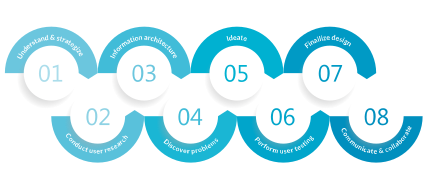
1: Understand the product and set up a strategy
Familiarize yourself with product vision and strategy
Your first step is to understand the product’s “big picture” and the vision behind it. You’ll need to answer the following questions:
- What problem the product is solving?
- What value is it delivering?
- Who are the users?
- Who are the competitors?
- Who are the partners?
Conduct stakeholder interviews
In order to answer the questions above, you’ll need to meet with project stakeholders. In your interviews with them, ask for the following:
- Mission statements, strategy documents, organizational or team structure charts, etc.
- KPIs (key performance indicators) − to help you understand the most important features in the product by understanding what success looks like.
- Previous research they’ve conducted − including user research, market research, competitor analysis, etc.
Create a roadmap
Roadmaps facilitate team collaboration and clarity around priorities. Create a roadmap to help your team better understand:
- What is the ideal state of the product?
- What is the current state of the product?
- What steps need to be taken to meet the end goal and how should you prioritize them
2: Conduct user research
User research is one of the most important steps in the product-design process. All of your team’s hard work, time, and money will be worthless if you end up making a product that no one wants to use or that can’t compete in the market.
Here are some research methods to help you better understand your users and competitors:
- Establish user personas: A persona is a hypothetical character created to represent a major user group that might use your product in a similar way. Create user personas to better understand your product’s users and their needs, goals, and pain points. To create user personas, use the data you gathered in stakeholder interviews, conduct surveys, interviews, ethnographic research, etc.
- Create a user journey map: A user journey is the path a user takes through your product to achieve a certain goal. User journey maps show users’ thoughts and feelings while using the product or going through that journey. This makes it easier for you to identify areas for improvement since you see when your users are annoyed, confused, or happy. Develop your user journey maps using the feedback received through user testing, observations, data received from the support team, etc.
- Conduct a competitive analysis: Conduct market research or a competitive analysis to learn what other similar products or companies are doing and analyze how their problem/solution could map to your own problems.
3: Define your information architecture
Information architecture helps you organize and structure the content of your product in a way that your users can find what they are looking for easily without having to go in circles. Create this structure for your product through any of these methods:
- Site maps
- Flow charts
- Card sorts
4: Discover problems
Discovery is an important phase that allows designers to work with the entire team to define and research problems identified in steps 1-3, as well as gather enough information and initial direction on what to do next. Discovery will help you frame problems with all the evidence you need before moving to the ideation phase.
5: Ideate
The ideation phase moves you from learning about your users and the problem to coming up with potential solutions. In this phase, gather together and come up with as many ideas as possible. The focus is on quantity, not quality.
Some ideas may surface as the potential solutions to your problem. Others will end up in the reject pile. If carried out properly, an ideation session can lead you to find that groundbreaking solution that you and your users are looking for.
6: Perform user testing
User testing gives you the opportunity to evaluate and validate your ideas with the users. At this stage, you’ll be able to gain deep information about your users’ behavioral patterns, preferences, and suggestions. Testing early during the design process allows you to prevent future re-design costs and to launch a user-friendly product.
7: Finalize the design
With the usability testing complete, you can start updating the design according to the feedback you received. You will now design what the screens will actually look like and create the final UI through high fidelity wireframing and prototyping.
8: Communicate and collaborate
Your last step is to share the design with developers and walk them through the entire user flow to give them the opportunity to review what needs to be implanted and raise any questions or concerns. Once the development starts, you might need to do any of the following tasks:
- Support developers : Provide guidance and answer questions about how things should look or work.
- Update: If there are technical limitations with implanting the design or new issues arise, get more user feedback and update the designs again.
- Review and desk check : When the development is completed and pushed to the test environment, review the work to make sure everything matches with your design.
The benefits
If you follow this process, you’ll be able to develop products with:
- More efficiency: Time, effort, and cost will be reduced by discovering and testing different ideas early in the process and moving forward with the solution that works best for both customers and the business.
- Higher customer satisfaction: Continuous research helps you understand and respond to users’ needs so that you are more competitive in the market, which helps you increase customer satisfaction remarkably.
- Accelerated development: Providing high-fidelity design and working closely with developers throughout the process prevents them from making changes and fixes that are avoidable (such as when mocks are not detailed enough or when they make the wrong assumptions), resulting in faster development.
This high-level overview is a great starting point, but every organization and product has different needs. If you’d like to talk about how to improve your current product development process or how to establish a new one, contact us today.