
We've Solved Visibility — We Haven't Solved Responsibility
Over the last decade, the technology industry has made enormous progress in observability.
Modern enterprises can now observe virtually everything. Applications, infrastructure, networks, cloud resources, user experience, security events, business transactions, and AI workloads all generate streams of telemetry. Dashboards are richer, and data lakes are deeper. AI-powered analytics can detect anomalies long before human operators notice them.
Yet outages continue. Performance issues still impact customers. Security incidents still take too long to diagnose. Applications still suffer from fragmented ownership.
The reason is simple: observability tells us what is happening. It does not guarantee that anyone can effectively act on that information.
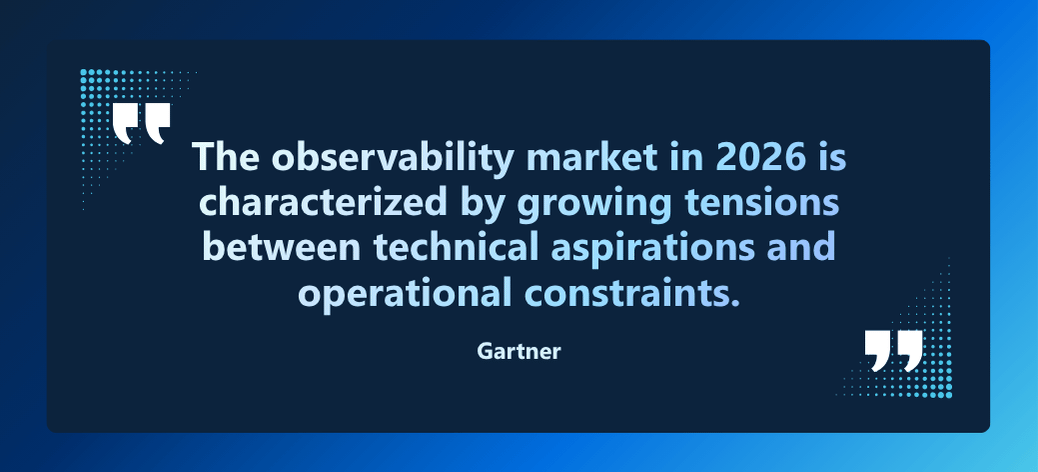
In Gartner’s 2026 Magic Quadrant report for Observability Platforms, their market overview stated: “The observability market in 2026 is characterized by growing tensions between technical aspirations and operational constraints.”
The challenge facing enterprises today is not a lack of observability, but a lack of operability.
The Great Observability Paradox
The promise of full-stack observability was compelling. If organizations could collect signals across every layer of the technology stack, they would gain unprecedented insight into system behavior.
That promise was delivered.
The unintended consequence is that many enterprises now have visibility into problems that span dozens of teams, vendors, technologies, and operating models.
Consider a modern digital experience. What once involved a simple connection to a SaaS application now spans virtual desktops, identity platforms, endpoint agents, SD-WAN infrastructure, service providers, security controls, cloud services, data platforms, and, increasingly, AI agents.
When degradation occurs, observability can identify where it happened. What it cannot determine is who owns the outcome. The paradox is that the more visibility enterprises gain, the more obvious the operational fragmentation becomes.
From Full-Stack Observability to Full-Stack Operability
The next evolution is not more dashboards. It is organizations like New Era Technology that deliver operational accountability across the entire stack.
What enterprises increasingly need is what I describe as
full-stack operability.
Full-stack operability is the ability to:
- Observe the environment end-to-end
- Correlate events across technology domains
- Determine how issues impact your business
- Coordinate response across all providers
- Execute remediation regardless of technology boundaries
- Continuously optimize performance and resilience
Someone must own fixing it.
Why Traditional Managed Services Fall Short
The managed services industry was built around technology silos.
- Network managed services.
- Facility managed services.
- Cloud managed services.
- Security managed services.
- Application managed services.
Each service evolved independently and was typically optimized for a specific domain. In today’s environment, the operational model must evolve to reflect that reality, and a new type of MSP must emerge. It’s not a network MSP, not a cloud MSP, not a security MSSP, but a full-stack operations provider.
Doesn’t AI Solve the Operational Fragmentation?
No, AI accelerates the need to solve operational fragmentation. On the one hand, the digital experience will only become increasingly complex as AI workflows expand their dependencies across models, data pipelines, inference environments, cloud infrastructure, governance controls, and user-facing applications.
On the other hand, AI creates the opportunity to automate large portions of operational management. But it does not address the organizational operating model required to diagnose, solve, and optimize the experience.
The future operating model will likely combine:
- AI-driven observability
- Automated incident correlation
- Autonomous and AI-driven remediation with Human on Loop oversight
However, even as AI becomes more capable, the question of accountability remains unchanged: Who owns the outcome?
The answer is not “everyone and no one.” The answer is a full-stack operator capable of operating across the entire technology stack.
How Does New Era Solve the Full-Stack Operability Gap?
Full-stack operability demands a different type of company, a different type of operating model — not defined by another dashboard, point tool, or siloed support model.
This is where New Era Technology is leading the industry as a full-stack operations provider.
New Era Technology extends operational excellence beyond traditional IT support by unifying disciplines such as CloudOps, SecOps, NetOps, DataOps, AIOps, AgentOps, LLMOps, and site reliability engineering into a single operating framework. Rather than managing technology silos in isolation, we treat the entire digital ecosystem as an interconnected service that requires continuous monitoring, governing, optimizing, automation, and improvement.
As AI becomes embedded into every business process, this continuity becomes even more critical. We won’t manage the future through isolated operational teams that own pieces of the stack. We will manage it through fully observable, intelligent, automated, and integrated operational ecosystems.
New Era Technology operates the full stack, turning observability into accountability, action, and measurable business outcomes.